 English
  Norsk
Norsk  Polski
  Lietuvių kalba
General information about inheritance law
When a person passes away, there is a need for rules on what should happen to the assets and liabilities that the deceased leaves behind. Inheritance law sets out the rules on who is designated as heirs and how assets are distributed between them. Furthermore, inheritance law provides rules for probate proceedings, i.e. the process from the time of death until the deceased's creditors have received what they are entitled to and the inheritance has been distributed among the heirs.
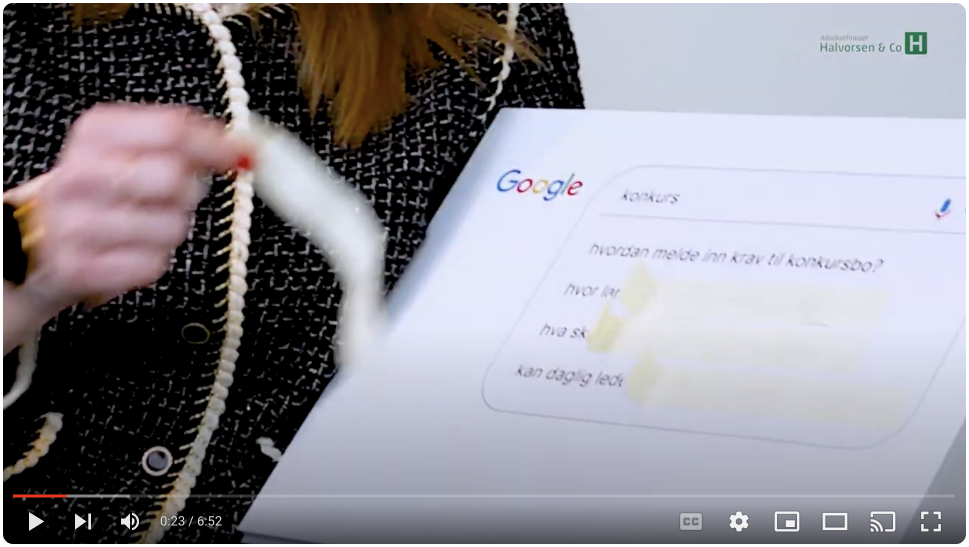
Our lawyers answer frequently Googled questions about inheritance law
Watch the video nowInheritance law affects us all, and the issues related to this field often have major consequences for individuals. The law firm Halvorsen & Co has solid expertise in the field of inheritance law. Our work with both inheritance planning and inheritance settlements enables us to identify potential conflicts and contribute to the preparation of wills and prenuptial agreements that prevent the parties and/or heirs from coming into conflict later. We always endeavour to find good solutions for our clients in line with their wishes and in accordance with the law.
Reasons to choose Advokatfirmaet Halvorsen & Co:
- Lawyers with extensive experience and expertise
- Ability to see good solutions for the client
- The lawyers are accessible, fast and provide good service
Who inherits who?
Inheritance classes
If the deceased has not made a will, the inheritance is distributed according to the Inheritance Act's system. The Inheritance Act's system is based on three classes of inheritance:
- The first inheritance class is the deceased's heirs (the deceased's children, grandchildren, great-grandchildren and so on).
- The second inheritance class is the deceased's parents and parents' offspring (the deceased's siblings, the deceased's nieces or nephews and their children).
- The third inheritance class is the deceased's grandparents and the grandparents' offspring (the deceased's aunts and uncles and the deceased's cousins). The third inheritance class is limited to the deceased's cousins. This means that children of the deceased's cousins have no right of inheritance.
The Inheritance Act's system is based on the idea that each inheritance class must be exhausted before the inheritance goes to relatives in the next class. This means that the deceased's parents have no right of inheritance if the deceased leaves life heirs. Similarly, the deceased's grandparents do not inherit if the deceased is survived by parents.
Inheritance rights of spouses or cohabitants
The deceased's spouse does not constitute a separate inheritance class, but the spouse also has a statutory right of inheritance. The surviving spouse inherits ¼ of the deceased's assets in cases where the testator has heirs, and ½ of the assets where the testator has no heirs. If the deceased only has relatives in the third inheritance class, the spouse inherits everything. In some cases, cohabitants may also have a statutory right to inheritance. This applies first and foremost if the cohabitants have, have had or are expecting children together. The surviving cohabitant is then entitled to a so-called minimum inheritance (4 times the National Insurance basic amount).
How much does each heir inherit?
How much each heir is entitled to depends, among other things, on whether there is a will for the deceased. If the deceased did not have a will, the inheritance is distributed in accordance with the inheritance classes in the Inheritance Act. If the deceased leaves behind a spouse and two children, the spouse inherits ¼, but still at least 4 times the National Insurance basic amount. The two children inherit the remainder, with an equal share for each.
Testation options for the testator
If the testator wishes the inheritance to be distributed in a way other than what is stipulated by law, he or she can make a will. The testator's freedom to decide on inheritance in a will is limited by the rules on «forced heirship». According to the rules on intestate succession, two thirds of the testator's assets are reserved for the heirs. However, the compulsory portion of the inheritance is never greater than 15 times the basic amount of the National Insurance Scheme for each of the testator's children, or for each child's line. Furthermore, the freedom of testation is limited by the spouse's (or in some cases the cohabitant's) right of inheritance. The testator can therefore only decide on the part of the estate that does not constitute a forced heirship or spouse/cohabitant inheritance. How much of the estate the testator can control in a will therefore depends on the size of the estate. In some cases, the spouse's minimum inheritance and the marital inheritance will eat up so much of the assets that there is little or nothing left to bequeath. If you are wondering what you can decide in your will, please contact us for assistance.
Should you choose intestacy?
«Uskifte» means that the "probate" or inheritance settlement after the first deceased spouse is postponed. In practice, this means that the surviving spouse takes over all values and assets after the first deceased, and that any heirs' inheritance rights are postponed until the undivided estate is distributed (settled) at some point in the future. The alternative to intestate succession is probate, which means that the inheritance of the deceased is settled immediately.
Spouses have the right to sit in an undivided estate with joint ownership, in relation to joint children. If the deceased had special children, intestate succession requires the consent of the deceased's special children. Whether or not it is wise to choose intestate succession depends on an overall assessment of, among other things, the deceased's assets and debts. It is important for the surviving spouse to realise that if intestate succession is chosen, the surviving spouse will take over all the obligations of the deceased. This means that the surviving spouse will be responsible for all debts left by the deceased. The spouse must therefore obtain a good overview of the deceased's assets before deciding on intestate succession.
Furthermore, it's also important to realise that any claims for division, both on the part of the first deceased and the longest surviving spouse, will be lost if intestacy is chosen. Read more about division of assets here.
Restrictions on disposal during the intestacy period
As a general rule, the surviving spouse has control over the entire undivided estate. The Inheritance Act does, however, impose certain restrictions on the right of disposal. The restrictions are mainly that the surviving spouse cannot give away large gifts or inheritance settlements from the undivided estate. If, for example, the surviving spouse has made a gift in breach of the restrictions, the heirs can demand that the gift be cancelled. For most people, the restrictions on disposal are not perceived as problematic, and the vast majority will be able to live well without the restrictions on disposal preventing this.
What situations lead to the distribution of the undivided estate?
Certain situations mean that the undivided assets must be distributed. Firstly, the surviving spouse can change the undivided assets with the heirs at any time. Secondly, the undivided assets must be distributed when the surviving spouse dies. Thirdly, an heir can demand a distribution of the intestate property if the surviving spouse disposes of the property in a reprehensible manner. Fourthly, the right to the undivided estate is cancelled if the surviving spouse remarries. Furthermore, an heir can demand a change to the undivided estate if the surviving spouse has had a cohabitant for two years.
How are the intestate assets distributed?
How the intestate property is distributed between the heirs depends on the property regime agreed between the deceased and surviving spouse. To read more about the division of assets between spouses click here. If the spouses did not have separate agreements on the division of assets (prenuptial agreement), the main rule of law is that everything the spouses own is jointly owned by the spouses.
If the spouses had joint property, the undivided estate must be divided equally between the first deceased and the surviving spouse's heirs. The division of a so-called «joint estate» is therefore relatively uncomplicated.
If the deceased spouse had separate property, the marriage contract must stipulate that the other spouse has the right to sit undivided with these values. The separate property values mean that the value ratio between the spouses is not necessarily 50/50. For example, if the deceased spouse has separate property assets totalling NOK 2 million and the parties' joint property amounts to NOK 4 million, NOK 4 million belongs to the first deceased and NOK 2 million to the surviving spouse. The first deceased's share of the undivided assets is then equivalent to 2/3 of the total undivided assets, and the surviving spouse's share is equivalent to 1/3. This value ratio is determined at the time of the establishment of the intestate succession and continues throughout the intestate succession period. When the undivided estate is to be distributed, the total assets are divided according to the share that was set when the undivided estate was established.
Inheritance for cohabitants
Some cohabitants also have a limited right to intestate succession. Inheritance for cohabitants requires that the cohabitants have, have had or are expecting children together. The condition of joint children is absolute. This means that cohabitants cannot grant each other the right to intestate succession in their wills unless they have children in common. For cohabitants, the right of usufruct is more limited than it is for spouses.
If you are in doubt as to whether you should opt for intestate succession, or if you have other questions related to intestate succession, our lawyers can assist you.
How to plan for inheritance settlements?
Today's society is characterised by greater prosperity than in the past. In addition, the traditional family structure is no longer as prominent as before. These factors lead to an increased need for inheritance planning because the distribution rules in the Inheritance Act do not necessarily suit families in today's society.
Decide on the inheritance by will
In a will, the testator can stipulate that part of the estate should go to specific persons or organisations. How much of the estate the testator can decide on in a will depends, among other things, on whether the testator has children or a spouse. Read more about the limitations in the right to make a will here.
Prepayment of inheritance
Every person is free to dispose of what they own during their lifetime. Provided that the transfer materialises while the testator is still alive, he or she can give away as much of their wealth as they wish. If the testator wants the favourite child to receive more than the other children, the testator can give away money or other assets to the favourite child without the others being entitled to similar assets. However, many parents want their children to inherit equally. If a child is in need of financial help, the parents can give the child assets and at the same time decide that the assets should be deducted from the recipient's future inheritance (reduction). In this way, the children ultimately inherit the same amount.
Generational change
The term «generational change» encompasses all transfers of assets from one generation to another. The aim of generational succession is to transfer assets to the next generation in a good and appropriate way, without creating conflicts. The question of generational change often arises when transferring a family company from one generation to another. The question then becomes whether it is appropriate for the next generation to continue running the company, or whether it is better to sell the company and realise the values.
The law firm Halvorsen & Co has extensive experience of succession planning. Contact us for a professional assessment.
Future power of attorney or guardianship?
Dementia or other serious illnesses can mean that people are no longer able to take care of themselves. If you create a power of attorney for the future, you can decide that someone you trust can look after your interests when you are unable to do so yourself. For example, you can stipulate in the power of attorney that the attorney can sell property and make financial and personal decisions on your behalf.
The alternative to a future power of attorney is to establish guardianship for those who can no longer look after their own interests. In the case of guardianship, the Governor decides who will be the guardian, and the guardian must seek authorisation from the Governor to carry out major transactions such as the sale of property. A power of attorney for the future provides greater flexibility and self-determination. The person appointed as a proxy in the power of attorney can, by virtue of the power of attorney, make decisions without seeking authorisation from the State Trustee.
The principal can also customise the power of attorney and stipulate how the attorney should carry out the assignment. For example, the principal can decide that he or she wants to travel or be taken on cultural experiences.
We help you set up a future power of attorney that is customised to your family situation and your needs.
Is there tax and duty on inheritance and gifts?
There is currently no tax or duty on inheritance and gifts. However, it is important to remember that inheritance and gifts can trigger other taxes and duties on the part of the recipient because the recipient enters into the donor's tax position. If the donor is in a tax position, the recipient will also be. It is also important to remember that ordinary inheritance settlements are exempt from stamp duty, but that this does not apply to inheritance advances.
There is political disagreement as to whether inheritance and gifts should be taxed separately. If there is talk of a reintroduction of inheritance tax, contact us for advice.
Click here here to read more about inheritance tax.
Do you have questions about inheritance and tax? Get in touch with one of our experienced lawyers today.
Public or private probate?
When a person passes away, a so-called «estate» is created. The estate consists of the deceased's assets, debts, rights and obligations. This means that an estate includes more than just household goods and chattels, as the term is often understood in everyday language.
When settling an estate, the deceased's debt obligations must be covered and the deceased's assets must be distributed. This process is called a «probate». The probate can be carried out publicly or privately. An alternative to probating the estate is to postpone the probate to a later date, a so-called «uskifte». If you're wondering whether it's worthwhile to postpone probate, read more about this here.
Private probate
In the case of a private probate, the heirs carry out the probate themselves. The heirs are responsible for, among other things, realising
assets in the estate, and to settle debts. How time-consuming the settlement of the estate is depends, among other things, on what is included in the estate. The heirs can also be assisted by a lawyer.
In order to settle the estate privately, it is required that at least one of the heirs assumes responsibility for the deceased's debts. Before the heirs take on this responsibility, they should therefore ensure that the debt does not exceed the value of the estate. The district court gives the deceased's heirs 60 days to decide whether they want to take over the estate for private probate. The heirs can thus use this time to gain an overview of the deceased's obligations. If the heirs are unsure how much debt the deceased had, they can ask the district court to issue a proclamation. A proclamation gives the deceased's creditors a deadline of six weeks to report their claims.
Public probate
A public probate is opened if one or more of the heirs so request. In a public probate, the district court is formally responsible for carrying out the probate, but in practice the task is delegated to permanent lawyers. A lawyer who carries out the probate on behalf of the district court is called a «trustee».
Public probate is particularly relevant if there are conflicts between the heirs, or if the heirs have little or no overview of the deceased's assets. In the case of public probate, costs are incurred for the trustee and the district court. The costs are covered by the estate.
Seinor lawyer Espen Larsen of Halvorsen & Co has extensive experience as a trustee in private probate. Please feel free to contact us if you need assistance in settling an estate or to clarify what is most appropriate before opening probate.