 English
  Norsk
Norsk  Polski
  Lietuvių kalba
Written by senior lawyer Ellen Tangen Eilerås and lawyer Nicolai Dybvad.
Introduction
Evaluation of tenders received in the procurement process involves assessing and ranking the tenders on the basis of the award criteria set out in the tender documents. Through the evaluation, a winner of the competition will be selected. The winner is the party that has submitted the best tender based on the award criteria.
In August 2022, the Directorate for Public Management and Financial Control (DRØ) published a new guidance on evaluation of tenders in connection with procurements. The guide is intended to help the public sector choose the supplier with the best offer, taking into account price and quality. . Previously, a methodology in the form of scoring and weighting has been common, with the highest score winning. DFØ now recommends a new quantification of the qualitative characteristics of the delivery. The result is that the best price with deductions for quality is declared the winner,
Use of evaluation models and approach
Evaluation model is a term for a method of evaluating offers with elements that are not directly comparable. Price is easy to quantify, while quality is not as quantifiable. DFØ refers to the two evaluation models, the points model and quality pricing. Scoring models convert price and quality criteria into points through «weighting». The highest total score is designated as the winner. In contrast to the point model, pricing of quality means that quality is given a monetary value that is deducted from the quoted price. You are left with an evaluated offer price. The latter model is new and is recommended by DFØ.
price-quality offered quantified=evaluated offer price
DFØ believes that the new model gives the contracting authority the best prerequisites for conducting a «more accurate» evaluation than when using point models.
Illustration of point model:
Table 1: The points model
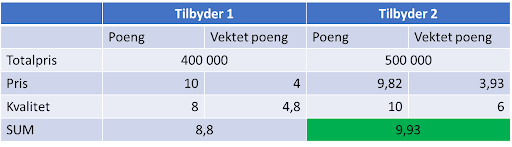
In the points model, both award criteria are converted into points. The points are then weighted according to the relative weighting and totalled. The highest total «wins».
Illustration of quality pricing
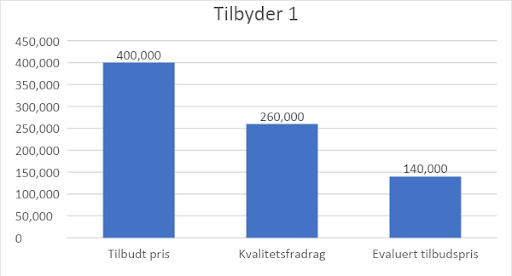
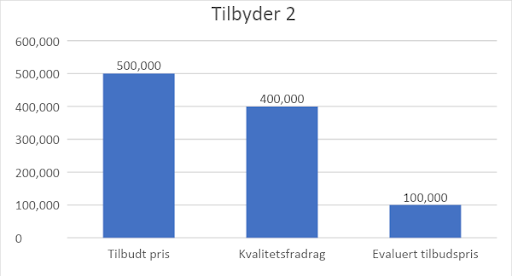
When using quality pricing, it can be seen that bidder 1 initially has the lowest price compared to bidder 2. However, bidder 2's delivery is of higher quality and receives a larger quality deduction than bidder 1. After the deduction, bidder 2 wins because it has the lowest evaluated bid price. The new methodology gives the contracting authority greater scope to reward relevant quality.
How to value the quality element?
The evaluation model that prices quality helps to raise awareness among decision-makers about how much they are willing to pay for good quality. The idea behind raising awareness is that quality adds value to the procurement. In DFØ's view, this will in turn increase the likelihood of the contracting authority selecting the right supplier as the winner of the competition. In the light of DFØ's recommendation, one question is how the public sector should use an evaluation model that prices quality in practice.
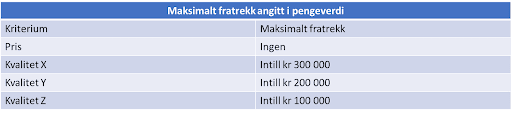
It may appear difficult to state an exact amount for the quality offered that will be deducted from the tender price. DFØ points out that awarding points for qualitative characteristics, as in the points model, will in principle be the same as valuing the quality element. The guidance recommends that the contracting authority specifies the maximum size of the quality deductions for the individual award criteria in advance of the call for tenders. This can be done as in the table below, which is taken from the guidance.
Table 2: Deduction table taking into account quality categories
DFØ also recommends that the contracting authority should assess the quality criteria without the evaluator knowing which tender price belongs to which tender. By carrying out the pricing «blindly», the contracting authority will further ensure equal treatment and independence in the selection process.
Assessment
The guide advocates a new evaluation methodology that differs from the points model. We believe that valuing quality elements in a more pedagogical way than before will create awareness of the quality of the tender. At the same time, there are also clear challenges in terms of how the evaluation is used in practice, and whether the client is able to fulfil the requirements for predictability and equal treatment. It will be exciting to follow the development of the evaluation model in the future.
Contact person